I am not sure why, but I love octopi. I think they are amazing, and so I give you the underdrawing and underpainting of a little octopus:
Ignore the shape under her, it will be changing/going away.
I have a new website, head over to katherinegriffinstudio.com for more posts!
Tuesday, August 25, 2015
Sebastian: Part 1
Growing up we usually had two kittens, then they turned into three, and then five (that was crazy, neighbors kept thinking we were the place to give found cats), and then back to three, and then two, and now one.
The "Primary Three" were Gershwin, Autumn, and Sebastian. Gershwin died about six years ago at 17 (that was hard), Autumn died three and a half years ago at 16 (that was harder), and now we are left with only Sebastian, a ginger tabby, who is almost 14 years old (don't tell him though, he thinks he is still a kitten).
Originally adopted as a Christmas present for Grandma, which was rejected (he would have been perfect), Sebastian was the cutest of kittens. Here is the drawing I have made up of him as a kitten:
Right now I am thinking that the background will be a light, light blue (which should help the orange in his coat to really pop), and his little paws will be teal.
Thursday, August 20, 2015
Colossal: The World's Oldest Multicolored Print Book has been Opened and Digitized for the First Time
The earliest example of multicolor printing is now available for the public eye, digitally available through Cambridge University Library's Digital Library Site. The 17th century book, Manual of Calligraphy and Painting (Shi zhu zhai shu hua pa), is so fragile that it was previously forbidden to be opened, its content a total mystery before its recent digitization...
The Cambridge site explains that although the skill required to achieve such douban prints is admirable, the gradations of color within the book is what led to its reputation as "perhaps the most beautiful set of prints ever made"...
Colossal: Sipping Turtle Tears in Ecuador
Colossal: A Pair of Butterflies Photographed While Sipping on Turtle Tears in Ecuador
Apparently if you're a thirsty butterfly, one option available to you is a refreshing sip of turtle tears. No, this isn't a staged photo masquerading as science, it's an unusual behavior known as lachryphagy (tear drinking), and is one of several ways butterflies obtain moisture and nutrients...
Labels:
About an Artist,
Wild Life and Animal News
My Modern Met: Solar-Powered Sea Slugs
My Modern Met - Solar-Powered Sea Slugs: The Rare Organisms with Plant-Like Qualities
Meet the Elysia chlorotica, a bright green sacoglossa found along the Atlantic coast of North America that's earned the title of "solar-powered sea slug" for its ability to produce its own energy with sunlight and the chloroplasts that it sucks off of algae. This unusual process, which is similar to photosynthesis, is known as kleptoplasty. Except for a select number of creatures like the adorable "leaf sheep" Costasiella kuroshimae nudibranch, very few non-plant organisms are capable of the phenomenon...
Wednesday, August 19, 2015
Cool Critters - Regal Ringneck Snake
Cool Critters - Regal ringneck snake (Diadophis punctatus regalis)
This colorful beauty is a subspecies of ringneck snake endemic to the southwestern United States and northern Mexico. They are among the larger of the ringneck snake subspecies, growing from 20 to 87 cm long. The regal ringneck snake is found in the mountains, not in the desert. The regal ringneck snake, unlike other subspecies, is almost exclusively ophiophagous, having a diet that consists primarily of other snakes. They have enlarged rear teeth and a weak venom that serves to immobilize their small prey, but is harmless to humans. Ringneck snakes are nocturnal, secretive snakes which spend most of their time hiding under rocks or other ground debris. If threatened, the ringneck snake typically hides its head and twists its tail in a corkscrew type motion, exposing its brightly colored underside, and expels a foul smelling musk from its cloaca.
Friday, August 14, 2015
Which Black should I Use: Lamp, Mars, Ivory, Payne's? Or No Black at All?
This morning I was looking over my last two posts (I made some changes to the post about supports, by the way, I added more information on how to pick a canvas and I changed a video) and thought to myself, but what about black? There are so many blacks!
To Black or not to Black
Let's discuss.
Today I will be covering the difference between the basic blacks (Mars Black, Ivory Black, Lamp Black, and Payne's Gray) as well as why black has a bad rap, and how to mix your own black.
Mars Black: Named for the alchemical name of iron, Mars, it was traditionally made from a black iron oxide.
Mars black is a matte, very opaque black with a warm, brown undertone. Not as "black" as some others on the list, but a mega strong tinter. This was the choice black for Neo-Expressionists, like Anselm Kiefer, who just wanted BLACK in their paintings.
Ivory Black: Named for its traditional processing method, roasting elephant tusks, it is related to its out of date cousin, Bone Black.
Ivory black is a semi-transparent black with a slightly warm, brown undertone. It is a blacker-black than Mars Black, and while a solid tinter, it is about three times weaker than Mars Black. It is the all-purpose black and is a solid choice for mixing grays and creating colored shades.
Lamp Black: Named for its traditional processing method, collecting the residual soot of burnt oil lamps (waste not want not), it is made of pure carbon and is one of the oldest pigments. It has also been called Carbon Black, Vine Black, and Charcoal Black.
Lamp Black is a semi-opaque black with a cool, blue undertone. It is great when you want bluer shades and cool blue grays.
Payne's Gray: Named after the 18th century water-colorist William Payne. Payne often recommended it to his students as an alternative to plain black and it is a mixture of Ultramarine Blue, Mars Black, and sometimes Crimson.
Payne's Gray is a semi-opaque black with a strong, cool blue undertone. It is the coolest black on the list and has a moderate tinting strength. Landscape artists like to mix it with different yellows in order to create varying tones of deep green.
How to Mix your Own Black
Light is additive, in order to get to black you would have to remove all light/color. In the real world, this doesn't naturally happen. Pigments are subtractive, in order to mix black you add all the colors together. Here are two ways to mix black:
1. Mixing blue with red and then adding yellow makes black. It can be a very pretty, dynamic and colorful black.
2. Mixing perfect compliments together will give you gray, but like the deepest gray possible...so really it gives you black. Matching perfect compliments can be difficult, if two colors are compliments, but not perfect you will get brown.
Gamblin has taken the guess work out of matching compliments for you with their Chromatic Black. It is a transparent black and is also neutral in color temperature. I have never tried it, but I think I want to.
The Bad Rap of Black
Monet painting at the Edge of a Wood, John Singer Sargent, 1887
Have you ever heard that you should never use black in your paintings, because black does not "exist" in the real world? Wanna know who gave black a bad rap? Impressionists. That's right... the most "beloved" of all, the Impressionists.
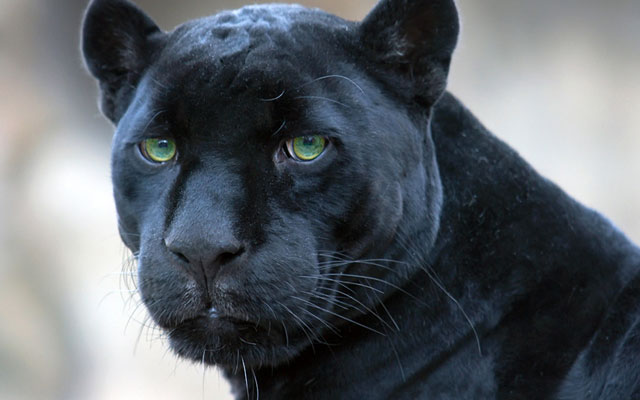
To be fair, straight black doesn't actually exist in the real world. Hold the phone! Really? What about black panthers or jaguars? Take a look, they are blue.
There is a nice little story about the above painting when Sargent was visiting Monet and asked Monet if he could borrow some paints. Here is the moment according to Monet:
"I gave him my colours, and he wanted black and I told him, 'but I haven't any,' 'then I can't paint' he cried, 'how do you do it?'"
(rolling eyes)
To Black or not to Black
I used to heavily camp out in the "No Black" club. Eventually I started wanting a black, so I mixed my black and I was happy to do it. Until I realized, "Man, I use a lot of paint to get the black I want." I didn't want to use a "plain" black, because using a black straight out of a tube can make your painting look a little dead and flat, but that isn't necessarily a bad thing:
Luncheon on the Grass, Edouard Manet, 1863
Color Temperature and Picking the Right Black
Using a tube black can help speed up the painting process, minimize the amount of wasted paint, and help you have more consistency throughout multi-day painting sessions. Knowing which black to use, with the right undertone and color temperature, is half the battle.
If you are mixing a warm black with cool colors in order to paint a cool shadow, you are going to get frustrated. Your black should always have the same color temperature as the colors you are mixing it into.
Ivory Black is a warm, all around great black. Add Ivory Black to warm colors to maintain a warm color temperature. Payne's Gray can really help you round out your palette as it is the coolest black. Add Payne's Gray to cool colors to maintain a cool color temperature.
If, however, you want to just have a neutral black that won't change the color temperature at all, use Gamblin's Chromatic Black.
All of the above information came from here, here and here. If you would like to read more about the cultural and historical significance of black, read here.
For more about other colors check out my main Tips and Techniques page.
Subscribe to:
Posts (Atom)